Industrial heat pump solutions for companies: lower energy costs, reliable heating and cooling, and a predictable return on investment.
In the energy consumption of an industrial facility, heating, cooling and domestic hot water production are often a bigger item than they first appear. Industrial heat pump solutions are therefore not a simple mechanical replacement, but a business decision: how to provide the same or better comfort, technological stability and operational reliability with lower energy demand.
On the corporate side, the question is rarely whether the heat pump is more modern — it is whether, in the given building, under the given load profile and fitted to the existing system, it actually delivers a measurable result. A warehouse, an office building, a workshop hall or a light-industrial plant operate with very different needs. That is why, in an industrial environment, a good decision is always based on a precise technical survey and a realistic payback calculation.
What does an industrial heat pump solution actually mean?
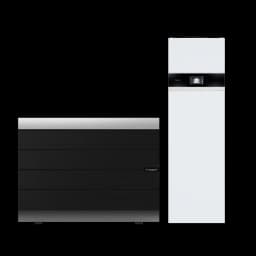
In an industrial environment, a heat pump can perform several tasks at once. It can provide the building's heating, deliver summer cooling, support domestic hot water production and, in certain cases, supply heat to technological processes as well. The key is not the equipment in itself, but the complete system design.
This matters because an industrial building generally does not offer laboratory conditions. Changing shift patterns, different zone temperatures, high ceilings, gate openings, internal heat loads and continuous operational requirements all influence how it works. An undersized or poorly controlled system quickly turns into a loss here. A well-designed system, on the other hand, does not only save energy — it also delivers more predictable operation.
Where do industrial heat pump solutions work well?
Most corporate decision-makers encounter this question where the existing gas-boiler or mixed system is already expensive to run, is ageing, or does not provide adequate comfort. Such sites can include offices and company premises, logistics centres, retail units, service halls, smaller production halls or multi-purpose corporate buildings.
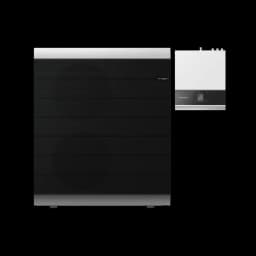
Air-to-water heat pump systems can in many cases be installed faster and with less intervention, so they can be a particularly good choice in projects where the transition time must be kept short. Geothermal solutions can be especially strong where stable efficiency is a priority over the long term and the installation conditions are in place. Not every site and not every investment is suitable for them, but where they are, very good operating parameters can be achieved.
Energy efficiency here is not a marketing word, but a number
One of the most important questions in industrial investments is the total life-cycle cost. It is not enough to look at what the purchase and installation cost. The annual energy consumption, the maintenance needs, the expected lifespan, the potential downtime risk and how well the system can accommodate later expansion are just as important.
The advantage of heat pump technology is that the same amount of delivered heat typically comes with more favourable primary energy use than with many conventional systems. This, however, is not automatic. The actual result is influenced by the flow water temperature, the building's heat loss, the type of heat emitter side and the quality of the controls. In plain terms: a good payback starts on the drawing board.
Anyone who truly wants to reduce costs must examine the system as a whole. In many cases, the best solution is not to replace everything one-to-one, but to intelligently integrate the existing infrastructure with the new technology. Hybrid systems, zoned controls, fan coil units or coordinating several heat generators often produce better results than an oversimplified replacement.
Designing industrial heat pump solutions: this is where success is decided
With industrial heat pump solutions, the design phase is not a mandatory administrative loop, but the most important part of the investment. First, the building's real heating and cooling demand must be surveyed, followed by the load peaks and partial loads that occur over the year. A selection based solely on nominal output can easily lead to mistakes.
The second critical point is the heat emitter system. With underfloor heating, ceiling cooling and fan coil applications, the heat pump can operate at particularly good efficiency, because a lower temperature level is sufficient. With older radiator systems, the picture is more nuanced. In some cases the system works well after modernisation, and in others the economics would be weaker without partial conversion.
The third consideration is operational reliability. For an industrial or commercial building, it is not acceptable for the system to run optimally only in good weather. Without backup operation, cascade configuration, proper controls and professional balancing, a system that looks good on paper can lose a lot in practice. Serious installation therefore always plans ahead for extreme operating conditions as well.
When does it really pay off in a corporate environment?
Payback is not a single universal number. It depends on current energy prices, how the building is used, the technology being replaced and whether government incentive programmes are available. When replacing an old system with high consumption and unpredictable maintenance needs, the difference is typically visible faster. With a newer but suboptimally running system, the main benefit will rather be long-term cost stability and better controllability.
The picture can be particularly favourable when the heat pump system operates together with renewable energy, for example solar power generation. In that case, not only can direct energy consumption be reduced, but energy independence also improves. Today this is no longer just a sustainability question, but a risk management consideration as well.
Corporate decision-makers often hesitate over how much a larger investment strains the budget all at once. Here, a whole-project perspective is important. A good partner does not just deliver equipment — they help compare technical alternatives, estimate the expected operating costs and, where relevant, review the incentive and financing options.
Installation and service: this is where the promise becomes reality
In an industrial environment, the quality of the installation directly affects daily operation. An imprecise hydraulic layout, faulty control logic or skipped system optimisation can increase consumption for months. That is why a good product choice is not enough. The installation and commissioning must be carried out with the same engineering discipline as the design.
The long-term service background is at least as important. What matters to a company is that professional support is quickly available in case of a problem, that there is a transparent maintenance regime, and that the system's performance remains predictable years later. This is the point where the manufacturer's commitment and local service capacity become real value.
Trident's philosophy in this is what serious investors look for: it is not built on selling a single piece of equipment, but on the whole process, from design through installation to reliable operation.
What mistakes should you avoid?
One of the most common mistakes is making the decision solely on the basis of the investment price. In the short term this is an understandable consideration, but with industrial systems, choosing too cheaply often comes with higher operating costs, weaker controls or earlier replacement.
It is also risky when the system sizing is based on estimates. Oversizing can be just as problematic as undersizing, because performance can deteriorate at partial load, cycling frequency can increase, and the real efficiency can fall short of expectations.
Another common misconception is that a heat pump works equally economically in every building without any modifications. Reality is far more nuanced. There are projects where outstanding results can be achieved with minor intervention, and there are those where certain elements of the building services or the building structure must first be put in order. The right professional recommendation is not always the simplest one, but in the long run this is what delivers security.
What should you pay attention to if you are considering an investment now?
If you are considering modernising a corporate property, it is worth first clarifying what goal you expect the system to achieve. The lowest energy bills, combining heating and cooling into one system, reducing gas dependency, or future expandability? Different technical answers can be given for the same building depending on which is the main priority.
The best decisions are usually made where the investor is not looking for a ready-made product, but for a working system. One whose expected consumption is known, whose payback is transparent, and behind which there is professional accountability even after installation. The real advantage of industrial heat pump solutions is not that they are modern, but that, well designed and well installed, they make the building's operation more predictable for many years to come.
Let's talk about your options!
Ügyvezetőnk hétköznap 09:00–17:00 között elérhető.